What was Wardenclyffe?
On Long Island, Tesla developed a station intended to transmit information and, in his larger vision, electrical power without conventional connecting wires. The facility was constructed during 1901–1905. It included a brick laboratory and a 187-foot tower. Financial trouble prevented completion; the unfinished tower was dismantled in 1917. [1][3]
That is already a remarkable engineering story. It does not need a successful worldwide energy system added to it retrospectively. The crucial distinction is between an ambitious design, a constructed facility, and a demonstrated service delivering useful power to distant loads.
What does the patent actually describe?
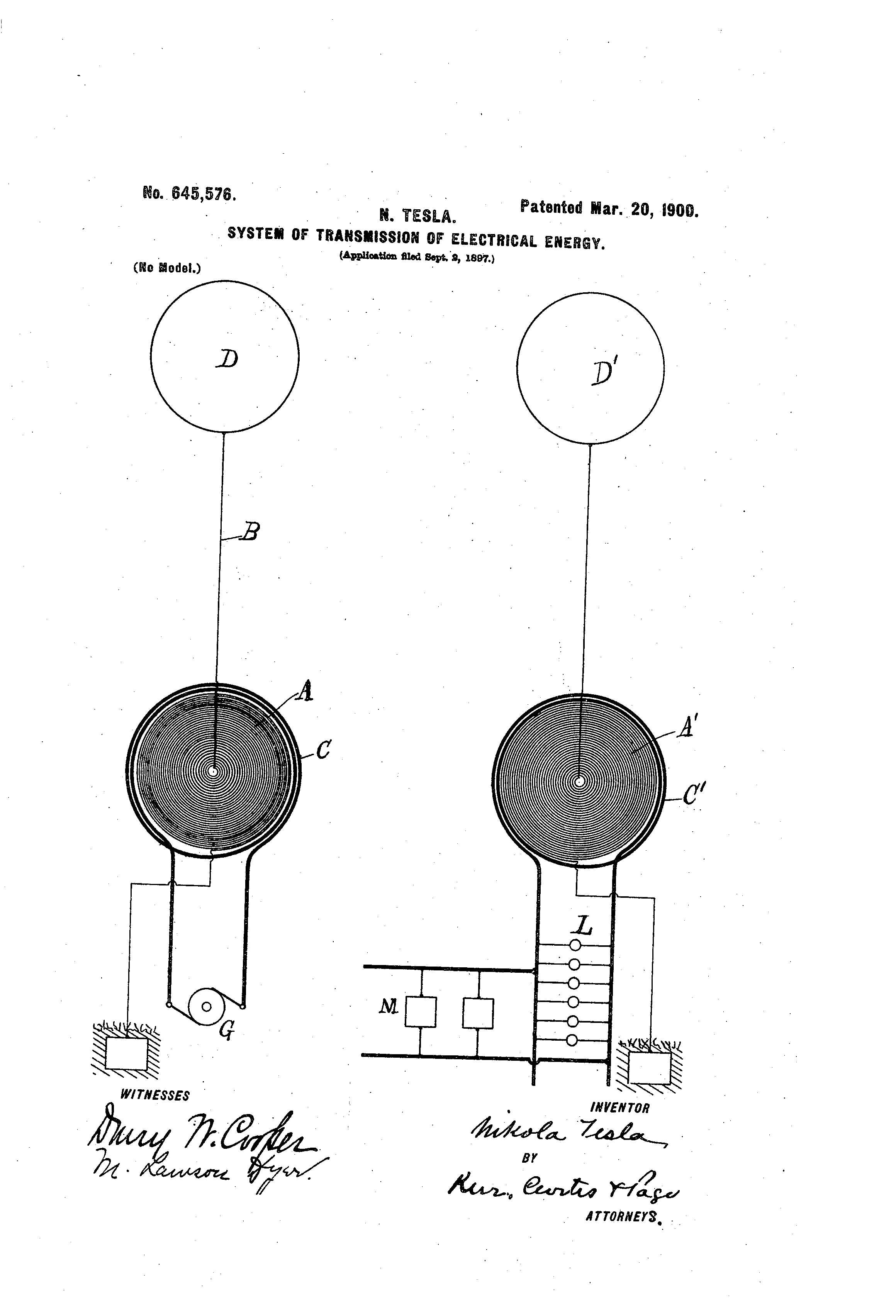
US 645,576 concerns electrical transmission. Its claims include a generating station, transformer circuits, earth connections, elevated terminals, and a distant receiving arrangement. Tesla proposed using the natural environment as part of the transmission path. The presence of a generating station matters: energy enters the system before anything reaches the receiver. [2]
Read the drawing beside the claim language. Identify where energy enters, which elements shape the signal, how a receiver couples to it, and where a useful load would connect. Do not assume that a component appearing in a drawing establishes its efficiency, operating range, or reliability.
This patent predates Wardenclyffe and is useful context for Tesla's thinking. It is not an as-built schematic or a commissioning record of the later site.
Wireless power does not mean free generation
- SourceEnergy supplied
- TransmitterConversion + losses
- EnvironmentCoupling + losses
- ReceiverUseful load power
Three questions are frequently mixed together: can a signal arrive, can enough power arrive to run a load, and is the entire system economical? A receiver detecting information does not answer the second or third question. A visibly lit lamp is interesting, but brightness alone cannot establish transferred watts or total efficiency.
For an illustrative test, if a transmitter consumes 100 watts while the distant load receives 5 watts, source-to-load efficiency is 5%. The other 95 watts must be accounted for in losses, other energy flows, or changing stored energy. Those numbers are an example, not a result attributed to Wardenclyffe.
Even ideal lossless transmission would deliver supplied energy, not multiply it. A cheap or unmetered receiver is a pricing arrangement; it is not a new energy source.
What would demonstrate the larger claim?
A useful modern evaluation needs a declared boundary and simultaneous source and load measurements. It should state distance, frequency, receiver geometry, operating time, nearby conductors, and uncertainty. Stored energy must be included at the start and end, especially when a short burst is compared with a long charging period.
- Measure real input power, including controls and auxiliary supplies.
- Measure useful output into a characterized load, not unloaded voltage.
- Repeat the test with the intended source disabled to identify unintended coupling.
- Publish calibration, raw time-series data, and unsuccessful trials.
- Have an independent team repeat the same procedure.
This is a measurement framework, not a high-voltage construction guide. Large resonant systems require qualified electrical and RF safety review. The replication page provides a recording template.
Questions worth separating
Was it an “aether tower”?
That phrase can collapse several different ideas into one. The historical sources cited here describe a wireless station; aether extraction is a separate claim requiring separate evidence. Read our aether research paper for that distinction.
Did funding problems prove suppression of working free energy?
No. The site history establishes financial problems and an unfinished project. Those facts alone cannot establish a successful hidden machine or the motives asserted in later stories. [1]
Is modern wireless charging proof Tesla's global network worked?
No. A modern device must be evaluated at its own frequency, distance, power, and efficiency. Demonstrating one form of wireless transfer does not validate every proposed transmission system.
Sources and reading limits
These references support the specific claims marked above. A publication, patent, demonstration, and independently replicated result are different kinds of evidence.
- Tesla Science Center: The Tower
Site history from the organization preserving Wardenclyffe. Supports the construction period, intended purpose, financial difficulties, and demolition chronology.
- Nikola Tesla: US 645,576, System of transmission of electrical energy
Published March 20, 1900. Read the original drawing and claims; the patent is not a full-scale test report.
- Tesla Science Center: History of Wardenclyffe
Supports the site's laboratory and tower description and Tesla's communications-and-power ambitions.
For classification and correction standards, read how we evaluate evidence.